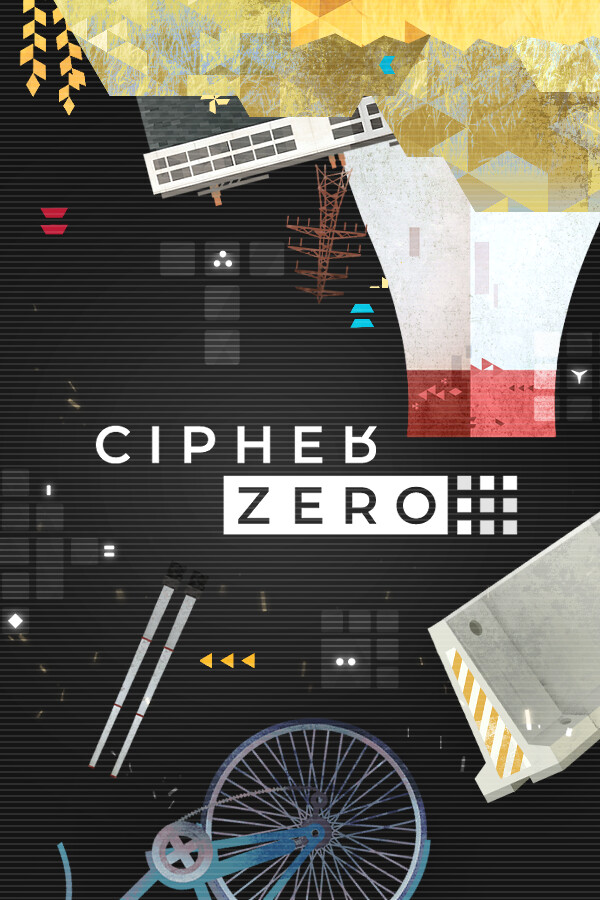
Cipher Zero
Difficulty : 3/5 (Rather Hard)
Global : 2/5 (Good – yeah I know it’s weird)
Cipher Zero got me interested right away, rule-discovery games are very rare and pretty much always end up being incredible.
That’s why I’ll be a bit rough with this one, Cipher Zero fails to grasp what makes this type of game so great and inevitably suffers from it.
Cipher Zero is a game about clicking on tiles, you’re presented with a grid with glyphs on it and the goal is to understand what these glyphs mean in order to know what to do and “deduce” which cells need to be activated.
This minimalist approach is the bread and butter of rule discovery games, a very basic and useful concept for experimenting to analyze the rules. The thing is… it turns out the rule-discovery part of Cipher Zero is completely secondary. Except maybe one mechanic, you’ll probably understand everything after a few extremely basic puzzles and that’s a shame.
The essence of rule-discovery games is to surprise the player, to make them believe they understand everything only to suddenly shatter that thought again and again. If the player never questions why their solutions are not working, then it’s not a rule-discovery game – it’s just a game that doesn’t hold your hand.
It’s really hard to play Cipher Zero after games like The Witness, Taiji and Understand. They all share the same formula and, despite the attempts at offering original mechanics, Cipher Zero fails where it matters the most.
Maybe you’re thinking I’m being unfair but Cipher Zero is advertised as a rule-discovery game, it’s legitimate to expect a lot more from this side.
What’s left is classic puzzles.
Each mechanic has its own tutorial section and gradually gets harder before being mixed with other mechanics. There are some fun sections, some mechanics have a good synergy and it allows the game to have a wide range of puzzles that constantly feel fresh. But there are also some… not that fun mechanics (the star glyph) and not every combination of mechanics works well. At least Cipher Zero makes the most out of its mechanics, that’s undeniable.
Overall I’d say the game is a breeze until the last two areas. You’ll still regularly be hit by unexpected difficulty spikes of course, sometimes a little line (which means you can only activate one cell in the row) can cause a lot of damage.
The two final areas of the game go all out to crush you, there are some seriously hard puzzles in there. I liked how they gloriously succeed at trapping you into thinking the possible looks impossible and the impossible looks possible. While some of them can really feel overwhelming, the game tries to keep the puzzles at a reasonable size.
Trial and error is king in Cipher Zero. A good amount of puzzles have a logical way to be solved, but it mostly concerns the easy ones. Once things ramp up just a little, you’re left with your instinct and gut feeling. It’s not necessarily a bad thing, but I have to go back to the rule-discovery part to explain why Cipher Zero suffers a lot from it.
If I spent so much time complaining about that aspect at the beginning of my review, it wasn’t only because of my unmet expectations. Cipher Zero has the gameplay and structure of a rule-discovery game but ends up being a classic puzzle game, and that’s a major problem for the puzzles themselves. Take any of the games I quoted earlier, they all have hundreds of puzzles. That works because they constantly bring something new, they have lots of mechanics and different contexts, and constantly add subtleties to them. The mixing process only happens later in endgame areas to really challenge you, and this is where trial and error in classic puzzles really kicks in. Otherwise the easy puzzles are there to experiment and study, and the harder ones add depth.
Cipher Zero is actually not a rule-discovery game, it tries to mimic them without ever trying to deepen its mechanics. It goes straight to the mixing part and as a result, you get hundreds of either filler easy puzzles that serve no purpose or medium-hard ones that are not rewarding.
I know trial and error doesn’t mean brain goes off. After playing with the mechanics for some time, you start to recognize patterns and develop a decent intuition. It’s an approach I don’t like that much but it’s tolerable when the number of puzzles stays moderate (like the endgame of any rule-discovery game or Cosmic Express for example), which is not the case for Cipher Zero precisely because it wanted too hard to feel like any real rule-discovery game and failed.
The various combinations of mechanics may still allow the puzzles to feel fresh, and like I said there are some genuinely fun ones (the one that makes you draw lines like a serpent was my favorite), but overall the game just doesn’t feel satisfying to play.
That’s why I have mixed feelings about Cipher Zero, it didn’t work for me. You either embrace the rule-discovery side completely or settle for a more traditional logical approach, or else solving that many puzzles is not very fun.
Otherwise, the game is polished and feels great with unique visuals and good sound design, the only problem I have is with the music. Some sections just have aggressive noise as background music and it quickly gets annoying (though I’m used to listening to extreme things but hey).
The absence of hints can also be rough. I never use them but Cipher Zero is completely linear with only one puzzle available at a time, and getting stuck for too long in this kind of game is discouraging for a lot of people.
After hearing so much praise, my expectations for Cipher Zero were far too high that’s for sure. It tries to be what it’s not and the good puzzles greatly suffer from that choice.
It’s not pleasant to say so many bad things about a game that is faaaar from being plain bad and, more importantly, clearly made with a lot of care.
Unfortunately, not recommended.
Developer: Zapdot
Publisher: Zapdot
Platforms: Steam – Windows/macOS/Linux
Release Date: July 22, 2025